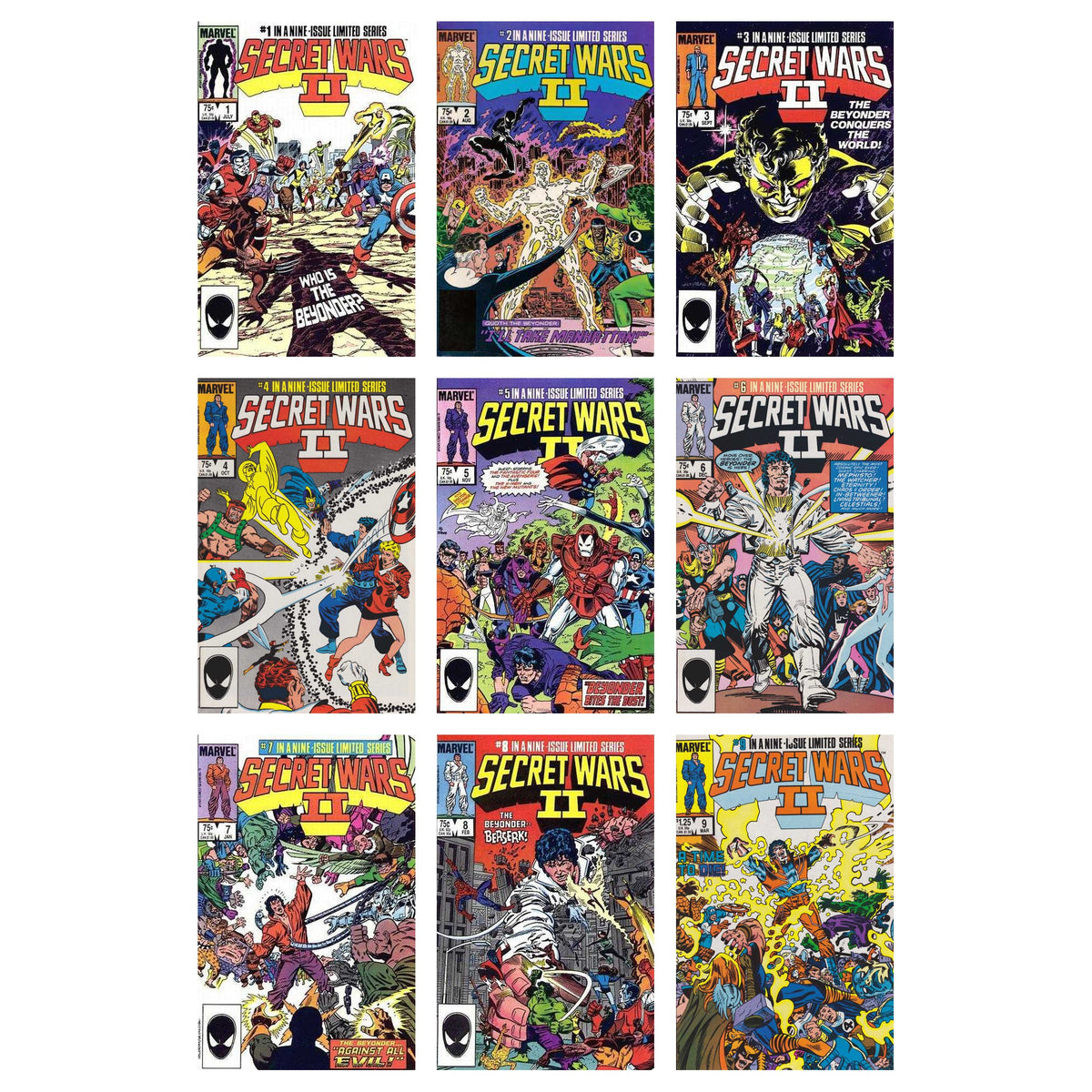
Secret Wars II is a
nine-issue comic book crossover limited series published by Marvel Comics from July 1985 to March 1986. Written by Marvel's then Editor-in-Chief
Jim Shooter and penciled by
Al Milgrom, it serves as the direct sequel to the highly successful 1984
Secret Wars mega-event.
The series is historic for introducing the concept of multi-title "crossover fatigue," as it was the first time Marvel structured a story requiring readers to buy issues of unrelated ongoing series to get the full narrative.
Plot Overview
-
The Arrival: The Beyonder—the omnipotent cosmic entity who orchestrated the first Secret Wars—travels to Earth in a physical form to truly understand human nature, desire, and the concept of "meaning."
-
The Exploration: Adopting a human body (modeled after Captain America), the Beyonder wanders Earth. He experiences mundane human things like eating food, accumulating wealth, and dealing with everyday social systems, often using his infinite reality-warping power to absurd extremes.
-
The Backlash: Frustrated by his inability to find true fulfillment, the Beyonder becomes increasingly unstable and dangerous. Earth's heroes (including the Avengers, X-Men, and Fantastic Four) and cosmic entities realize his emotional volatility poses an existential threat to the multiverse.
-
The Climax: The storyline culminates in a massive showdown where the heroes desperately attempt to neutralize the Beyonder before his growing frustration wipes out all of existence.
Key Features & Impact
-
Massive Crossover Scope: While the core story runs through Secret Wars II #1-9, it heavily spilled into 45 tie-in issues across titles like The Uncanny X-Men, The Amazing Spider-Man, Fantastic Four, and Thor.
-
Tone Shift: Unlike the action-packed, superhero-vs-villain battle royal of the first Secret Wars, this sequel plays out more like a bizarre, philosophical, and sometimes satirical character study of an omnipotent god trying to fit into modern society.
- The Tie-In Banners: This event popularized the now-standard practice of printing a distinct promotional logo banner on the cover of tie-in comics to drive sales.