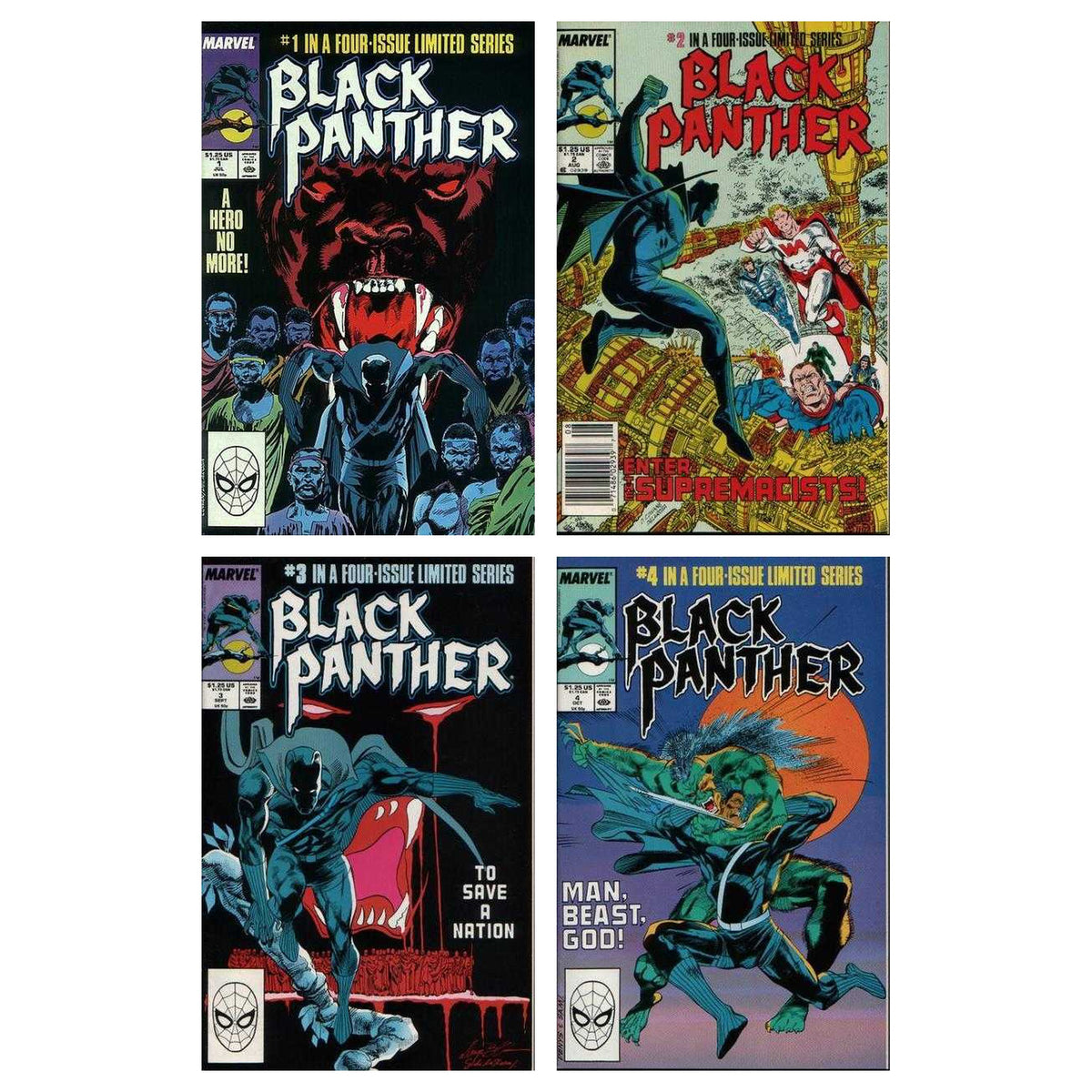
Black Panther #1-4 (1988) is a landmark four-issue comic book limited series published by Marvel Comicsfrom July to October 1988. Written by Peter B. Gillis with striking interior pencils by Denys Cowan, this series is highly historic as it represents the very first standalone Black Panther limited series in Marvel history, serving as a critical bridge between his 1970s jungle adventures and his modern political-thriller era.
Plot Overview
-
The Premise: T'Challa is struggling with his dual identity as both a global superhero and the active monarch of Wakanda, a nation whose isolationist policies are increasingly tested by modern geopolitical forces.
-
The Conflict: T'Challa travels to South Africa to investigate the brutal treatment of Black citizens under a fictionalized regime mirroring the real-world horrors of Apartheid. There, he clashes with Azania, a state-sanctioned team of super-powered white supremacists protecting the regime.
-
The Crisis: Back home, the stress of T'Challa’s international crusades triggers a spiritual crisis. The Panther God, displeased with T'Challa's focus on outside geopolitical conflicts over his direct duties to his people, temporarily strips him of his enhanced Panther abilities and his spiritual connection to Wakanda.
-
The Resolution: Left entirely mortal, T'Challa must rely strictly on his raw martial arts prowess, peak human conditioning, and brilliant tactical mind to defeat his enemies, reclaim his birthright, and restore his bond with the Panther God.
Key Features & Legacy
-
Real-World Commentary: The miniseries is widely praised for its mature, unflinching exploration of racism, state-sponsored oppression, and the moral responsibilities of a powerful nation like Wakanda on the global stage.
-
Defining the Lore: Gillis and Cowan deeply fleshed out the spiritual mythology of the Panther God (Bast), establishing the heavy psychological toll that comes with wearing the mantle of the Black Panther.
- Artistic Style: Denys Cowan’s gritty, angular, and deeply expressive pencil work perfectly captured the raw, grounded, and emotionally heavy tone of the narrative.